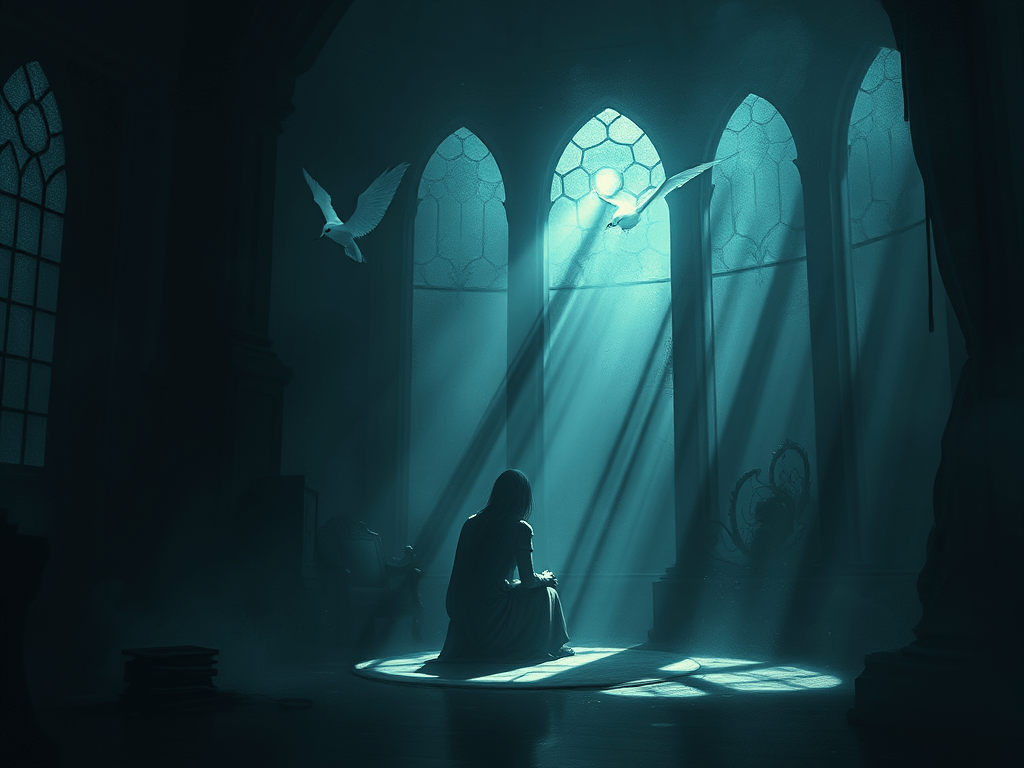
There’s a strange kind of comfort in the dark.
Not the soft dark of starry nights or candlelit rooms. I mean the other kind—the heavy, suffocating dark that swallows sound and makes time slow. The kind of dark you don’t want to admit you know.
Because once you’ve lived inside it long enough, it doesn’t just surround you. It shapes you. It seeps into your bones. It whispers that leaving would cost more than staying.
And that’s the hardest part to explain to someone who hasn’t been there.
Darkness isn’t always a threat. Sometimes it’s a home.
The Familiar Weight
There’s a reason survivors return to numbness, to silence, to shutting down. Not because it’s easy, but because it’s familiar. The dark doesn’t ask for explanations. It doesn’t demand joy, productivity, or even healing. It lets you sit in your nothingness and breathe without expectation.
And yet… it’s a trap. A home with doors that lock from the inside.
The longer you stay, the harder it is to remember what it feels like outside. The air feels thinner, the colors washed out. Hope begins to sound like a language you’ve forgotten how to speak.
Why I Write About It
I write dark fantasy because I know that feeling. I know the way silence can cradle you even as it devours you. The way secrets keep you alive, but also cut you in half.
The Mirrorlands in The Mirror Between Us are more than a fantasy setting. They’re the embodiment of this truth: darkness seduces. It comforts. It lies. But it also teaches us where our edges are, and what it costs to step back into the light.
Writing about it is my way of reminding myself, and maybe reminding you, that the dark is not the end of the story.
An Invitation
If you’re someone who feels more at home in the shadows than in the sun, I see you. I know that kind of belonging.
But maybe, just maybe, the darkness was never meant to be your home. Maybe it was the waiting room. The cocoon. The haunted place you had to walk through in order to learn that you were never unworthy of the light.
So if you’re still there, if you’re still sitting in the dark, know this: you’re not broken for feeling comfortable in it. You’re surviving. And one day, when you’re ready, you’ll step out and carry pieces of that darkness with you—not as a prison, but as proof.
Proof that you endured. Proof that you are still here.
The First Step Out of the Dark
Leaving the darkness doesn’t always look like running toward the light. Sometimes it starts with something so small it feels almost invisible. Opening the blinds for five minutes. Saying one honest sentence out loud. Breathing deep enough to feel your chest ache.
The first step out isn’t about banishing the dark, it’s about learning you can move through it without letting it consume you.
And here’s the secret: you don’t have to take that step alone. Someone can sit with you until you’re ready. Sometimes that someone is a friend. Sometimes it’s a therapist. And sometimes, on the hardest days, it’s a version of yourself you don’t quite believe in yet.
The dark will always call back. But every time you step out, even for a moment, you leave a marker behind. A lantern on the path. Proof that you can return to yourself, again and again.
Your Turn
Take a quiet moment and ask yourself:
What does the dark feel like for me? Is it a prison, a hiding place, or a kind of shelter?
Write it down. No censoring. No judgment. Just honesty.
Sometimes naming the shape of your darkness is the first step toward changing your relationship with it.
And if you feel like sharing, I’d love to hear what you discover. You can leave a comment below or just carry the words with you, like a secret reminder: you are not alone in this.
If this resonated with you, I’d love if you shared it—sometimes our words light the way for someone else still finding their first step out of the dark.
🖤 A.S. Thorne
 A.S. Thorne
Leave a comment